Ship Faster Without Lowering the Bar
Old me would have disappeared for three days, built the pack across every entity, made it beautiful, and sent it Thursday night. Then he'd have told me the second half wasn't what he meant. Instead he had a first draft within the hour. Half a day of actual work, all in.


Last month our investor relations guy emailed me asking for a new reporting pack for a group of important people. Different structure, new metrics, and he wanted a first version by the end of the week.
Old me would have disappeared for three days, built the whole thing across every entity, made it beautiful, and sent it Thursday night. Then he'd have told me the second half wasn't what he meant.
Instead he had a first draft within an hour. He had suggestions, so I tweaked it. Fast forward two more rounds of revisions and we had a final draft we could present externally. Half a day or actual work, all in.
The speed wasn't the interesting part. What got me was that a cheap first draft changed the shape of the work. I got a version in front of him early, while changing it was still cheap.
That isn't just about AI. Some dots connected and I wanted to explore if this is how product teams work. After a bit of digging, it turns out there are concepts from software companies we can borrow.
Change in finance is slow
Tell me if you disagree, but I think there isn't much innovation in finance and accounting. I’m not talking about software. I'm thinking the Excel models, the work papers, the processes.
A former colleague told me recently that a work paper I built for a month-end process is still in use and I left that job years ago.
Nobody gets promoted for rebuilding a working paper. You do get a very bad week if you break one. So the file survives, the process survives, and everyone (quietly) hates “month end”. The risk-reward never paid off, and nobody had a spare afternoon to go looking for something better.
That afternoon is cheaper now thanks to AI.
What product teams mean by "shipping"
It's the discipline of putting an unfinished thing in front of someone on purpose, early, to find out what you got wrong.
Three habits sit underneath it, and I used all three last month without planning to.
Small batches. I build the pack with one entity’s data first, not all of them. Research from Google’s DevOps Research and Assessment programme (‘DORA’) shows that small batches shorten feedback loops and make failures much easier to recover from. In practice it meant that when the structure turned out to be wrong, I'd wasted one entity's worth of work rather than twelve.
Fast feedback. The draft went out before I was comfortable with it. That's the whole trick, and it's the hard part.
Prototypes are disposable. The first pack wasn't a deliverable, it was me asking him if this was even the right shape. Rough commentary, no formatting, nothing pretty. I expected to bin it, which is exactly why I didn't mind sending it.
Question for you: can you break down a process or deliverable you are responsible for into smaller chunks and improve it somehow?
What I actually did
1. Planned it with Claude before touching any data. I pasted in the email from our IR guy and went back and forth on what the pack should contain and in what order.
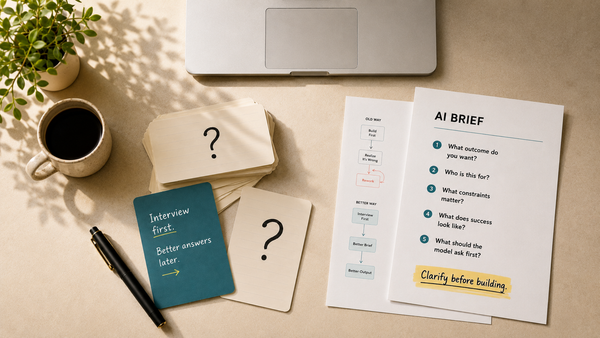
For screenshot examples of what “working with AI” looks like, refer to my post about how ending my prompts with “ask me clarifying questions” has improved my experience using AI.
2. Got Cowork to build a draft from one company's numbers.
Chat to plan, Cowork to execute.
3. Sent it before it was ready. He came back with changes.
He had suggestions on how to improve the layout and where metrics should go to better tell a story.
Two more rounds of that, and some time working on it myself, and we had something we could put in front of outside people.
A colleague of mine did the same thing from a different direction. She thought a macro in one of her team’s reconciliation spreadsheets could give them some time back but never had a spare day to learn VBA properly, so she built it with Claude instead.
In between month ends, she got Claude to build the VBA, tested it herself and then sent it to her colleague to get her thoughts. They are now using it to make their month end easier.
Not every door is a one-way door
Amazon's “Day 1” philosophy talks about splitting decisions into two-way doors and one-way doors. If you walk through a two-way door and don't like it you can walk back out. One-way doors don't let you.
Most of our work is a two-way door and we treat all of it like a one-way door.
Early drafts of commentary. Report redesigns. Dashboard prototypes. Exploratory analysis. The skeleton of an Excel model. All are reversible, all are internal (at first), and all are cheap to bin. That's where the speed belongs, and where AI earns its value.
The one-way doors are the material, external, hard-to-reverse work. Final board packs. Investor materials. Covenant certificates. Statutory filings. Anything an auditor is going to lean on.
You shouldn't push a new dashboard to your management team when those KPIs feed someone's bonus. You also shouldn't hand your audit partner a work paper you generated with Claude and never tested.
Recently another colleague used Claude to pull sales analytics from our CRM for a group of executives. Claude called the CRM via a tool call. When she reviewed it she found Claude had hallucinated some deals. She couldn’t find them when she went into the system. She did the right thing reviewing the output, because that's a one-way door and her name goes on it. She exercised "professional skepticism" (yeah, I said it).
Speed in the two-way doors is what buys you the time to be slow in the one-way doors. That's the actual trade we should think about.
The bar doesn't move
Doing this research has affirmed to me the power of smaller and smarter iterations. The win isn't lower standards or less trust. It's a lower cost of learning, so the final thing lands sooner and says something more useful.
Look at your next pack, report or whatever and find the two-way door. It may be the bit you spend four hours making pretty before anyone has told you it's the right thing to be making pretty.
Ship that bit ugly and early this month. Tell me what came back, I'd like to know whether this holds up outside my own desk.
Timon